


TLDR;
People are increasingly frustrated with the frontier LLM announcements that appear to be “too powerful” or “too dangerous” for the average Joe to run with.
First, we had the announcement that Anthropic’s “Fable” was pulled very shortly after release to comply with a US Government order:
The US government, citing national security authorities, has issued an export control directive to suspend all access to Fable 5 and Mythos 5 by any foreign national, whether inside or outside the United States, including foreign national Anthropic employees. The net effect of this order is that we must abruptly disable Fable 5 and Mythos 5 for all our customers to ensure compliance. Access to all other Anthropic models will not be affected.
More recently, OpenAI announced GPT 5.6 “Sol”, but then also announced it was a limited release with a lot of careful hedging based on Government oversight:
As part of our ongoing engagement with the U.S. government, we previewed our plans and the models’ capabilities ahead of today’s launch. At their request, we are starting with a limited preview for a small group of trusted partners whose participation has been shared with the government, before releasing more broadly. During this preview, we will continue testing and coordinating closely with partners as we work toward broader availability. We don’t believe this kind of government access process should become the long-term default.
Matthew Berman released a pretty good rant about it this week, following the “Sol” delayed release announcement from OpenAI -
In this article, we’ll get into how these limited releases are so much more than the veneer of safety, and so much more than just gatekeeping business competitive edge through regulatory capture.
Color Me Shocked (Not really)
I mean, I’m not one to say I told y’all so, but… three years ago, we knew this phase was coming. I spoke about regulatory capture at length in several podcast episodes, but one in particular focused on the “AI Insight Forums”, a series of closed door meetings held by US Senate members, led by Chuck Schumer, with the biggest CEOs (at the time) in attendance -
Mark Zuckerberg — Meta
Sam Altman — OpenAI
Satya Nadella — Microsoft
Sundar Pichai — Google
Elon Musk — X
Interestingly enough, Bill Gates — attended as well, though Microsoft’s chair/co-founder rather than sitting CEO.
You can listen to the episode here, later:

The first of nine closed-door forums convened on September 13, 2023. The first session set the tone: no access by the press and the public, and even senators wouldn't have the ability to directly ask questions of participants.
It seemed pretty clear that the fix was already going in, or at least, the lobby was going in, and that this “forum” was more like the interview process to see who was willing to play ball.
What I didn’t predict, as evidenced by the now outdated artwork from that episode, was that Anthropic would be one of the ones coming out the other end as a key player.
Now, I was fully aware of Anthropic even in the early (public) senate hearings. Dario was present and very vocal about how reckless OpenAI and others were being, but I kind of figured they would get drowned out by the big boys. I thought another clue was that Dario wasn’t the one who attended the Forum.
Since then, however, Google really did flounder (imho), no one talks about Llama much anymore, and I think Microsoft effectively paid $3.1 Billion for a neutered GPT-4 model.
But Anthropic flipped the dynamic by having Claude Code become such a successfully integrated part of the business world that they (and their profits) were impossible to ignore.
With their newfound footing inside the gates, they ramped the fear campaign to 11, and even though they got into a little bit of a tiff with the Department of War over allowing their models to aid in killing, it seems they’re getting their general wish of pulling up the ladder behind them.
And whether or not Dario Amodei genuinely believes in his crusade for AI safety, the reality is it ultimately doesn’t matter because the perceived threat will, for certain, be co-opted in ways that will make ISIS and WMD boogeymen pale in comparison to the scale of what comes next.
So while Matthew walks through all the obvious problematic scenarios in his rant above, he’s mostly focused on how regulatory capture will create unfair markets.
The idea is simple - if I only share my super capable model with a few of my closest and highest paying friends, the scale of acceleration they can achieve in even just a couple weeks of lead-time could amount to months or years of advancement over competitors.
And even if it’s not “let me get Fable early to make the next killer app early”, it could very well be “let me get Fable early to further optimize my stock or polymarket betting algo” or “crank ahead on research and patents so they get filed before anyone else”.
So, yes, of course these pre-releases will be abused for financial gain under the guise of public safety. But that’s the tip of the iceberg.

So much more.
From the same 2023 podcast episode I linked above, @ around 0:29:56 -
“…the very first thing that they (governments) do with it (game changing advanced technologies) is not guarantee their own sovereignty.
It is to either use it on their own population or use it to destroy another population…
…and the only thing, the only consistent piece that has ever equalized that playing field is when the distance between the technology that is available to the common man to defend themselves - and the technology available to the government to impose their will upon that population - is small.
That gap has to be small.
…somewhere along the way, they (governments) all pretty much learned: Not necessarily that you catch more flies with honey, but you can certainly suppress more flies and keep them around with fog and distractions than you can just killing all the flies that pester you.
And so the name of the game over the last few decades and millennia has been more around suppression, and ensuring that the population remains ignorant to the real truth and hiding uncomfortable truths between two lies, and essentially enacting control in such a way that the average person can’t even discern reality from myth.
That’s what we have to look forward to next. I’d bet real money there are models with cool codewords being trained right now that will never even be mentioned publicly, and their primary function won’t be to hoover up all of the good business ideas.
No, my friends, those models will be dedicated to multi-modal propaganda and social engineering on orders of magnitude we can hardly fathom.
And if you thought “Dead internet theory” was bad before, just you wait.
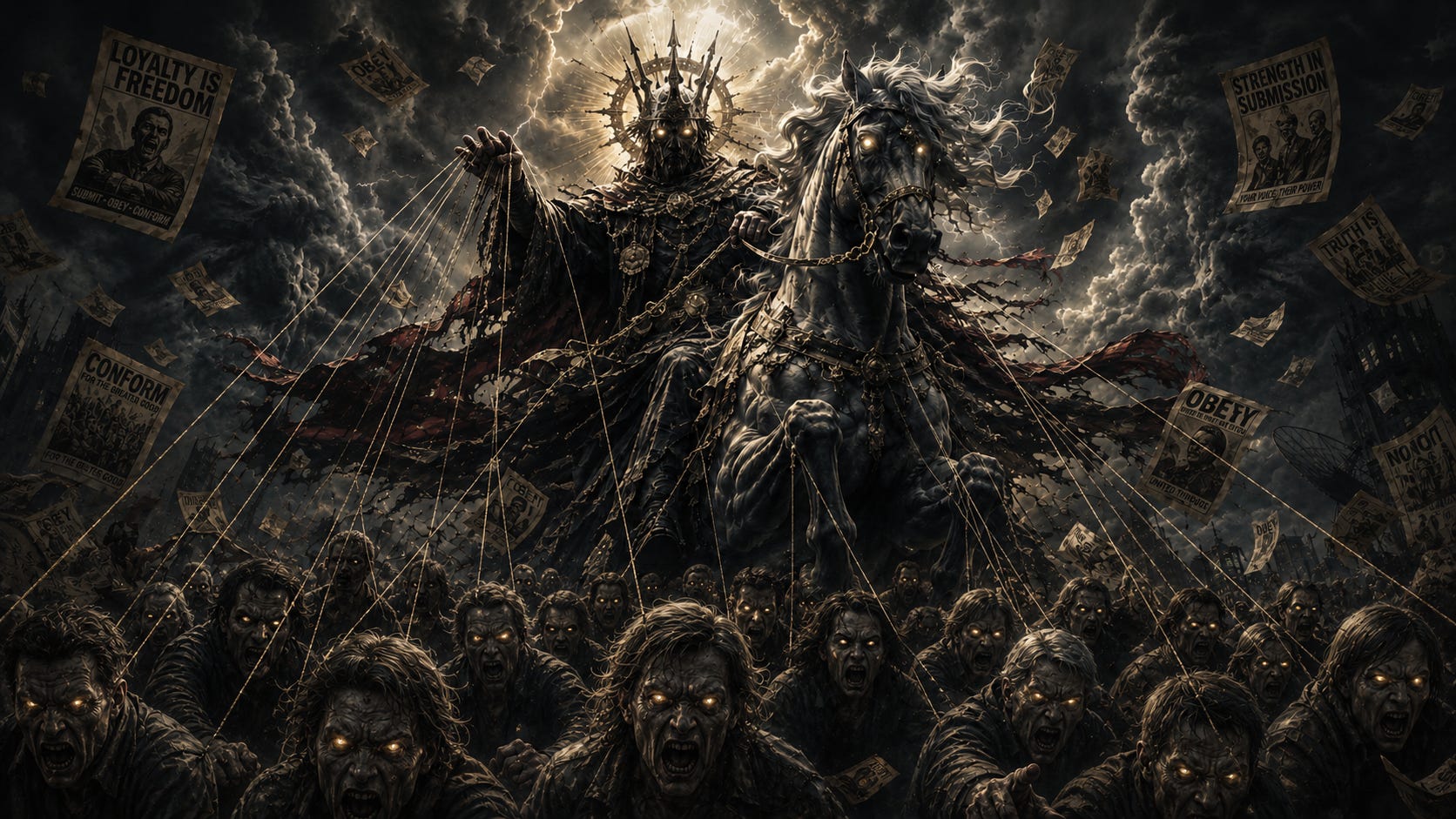
And lo, there came another rider.
Not War, though he stoked every desire for it.
Not Famine, though he emptied men of reason.
Not Pestilence, though his breath spread from mouth to mouth.
Not Death, though he taught the living to wish it upon others.
He descended through a storm of leaflets, broadcasts, and wireless frequencies. His horse was shod in rumor. His reins were woven from fear. In his hand were fiber optic threads, and beneath him the multitudes turned their faces outward with one unified, burning gaze.
And his name was Propaganda.
Manipulation on the Grand Stage
Consider, if you will, just a handful of converging AI technologies.
The first is voice cloning. Currently all the buzz is around a Qwen model (Qwen3-TTS) that apparently offers excellent voice cloning capabilities, and it’s open source. With just a short bit of audio from a person, you can essentially make them say anything.
Next, we have image generation. The latest here is "Krea 2” - which is not only touted as having excellent realism, but is also fully unlocked - which means the door for violence and, well, other stuff, is wide open.
And the final ingredient is video generation. Krea can do some video, but it looks as though the current move is to use a blend of several models, like Veo 3.1, Seedance 2.5, and Kling 3 - and chain them together in a studio like Higgsfield.

So you put the even more advanced versions of all of these together that you’ll never hear about, a next generation frontier model that’s powerful enough and smart enough to think through and plan all of the logistics and contingencies necessary, and you have a literal reality engine sitting in the hands of a few powerful individuals that’s capable of generating any situational event needed to steer the masses.
Like, it used to be you had to - I don’t know - pretend like certain cameras magically failed to capture footage of a plane going into a certain hexagonal building. Now you can just blow out an empty wing and generate perfect grainy CCTV footage of it happening from 3 realistic angles, complete with 5 eyewitness report interviews that never happened, drop a “leaked” audio recording of whoever you want to frame ordering the strike, and whatever other fabricated evidence necessary to make the panic plausible to act upon.
And the really crazy part is - if, after the damage is done - someone does manage to forensically prove that the whole thing was AI, the decision makers and the other powers-that-be will have deep-faked, catfished immunity as they bemoan “How was I supposed to know” into their press conference microphones.
Manipulation on the Not-So-Grand Stage
The real challenge is going to be how AI tools can and will rewrite the narrative in everyone’s back pocket. Here, it won’t take fancy video editing or spoofing politicians’ voices.
No, here you just need a strong enough model controlling a swarm of smaller harvester models that can quickly and deeply scan the web and all available public media for a story or a narrative that needs to be nudged in a certain direction. Within just a few planning sessions - a massive campaign of AI agents swarm out.
Maybe one agent has Wiki authoring influence. Maybe another runs a prominent twitter account. A third still can quickly pump out “news releases” to the Associated Press for redistribution to other outlets, and a fourth agent is serving as an active admin on a particular set of Reddit forums.
Together, they make subtle changes. Subtle suggestions. Small corrections that all appear to corroborate nicely should someone decide to do some digging.
Next, you take these “self improving LLMs” and slowly work in the suggested narrative, and manipulate the LLM’s training data to include the “new correct answers” you want it to provide. And when a user says- “I don’t believe you, cite sources” - the LLM will happily retrieve links to those same pre-manufactured sources and tell the user: “See, here’s the truth, just as I said.”
And the masses, who were already too jaded or lazy to scroll past the sponsored links in the Google days, will have low-to-no chance of making heads or tails of anything they didn’t go witness with their own two eyes.
Well that’s bleak - what do we do?
Here's the thing I keep coming back to, and it's the same thing I said on that podcast three years ago: the only force that has ever leveled this playing field is a small gap. Small between the power the government wields and the power the average person can reach back with. When that gap is small, honey works better than the knife. When it's wide, they stop bothering with either.
They are betting the gap gets very, very wide from here. So the whole game — your whole job, if you're not planning to go live in the woods and turn it all off — is to keep your side of that gap narrow.
You are not going to out-scale the propaganda machine. Nobody is. That's not the assignment. The assignment is narrower and a lot more achievable: make yourself expensive to fool.
Every fabricated CCTV angle, every deep-faked confession, every swarm of little agents nudging a Wikipedia edit — all of it runs on the assumption that you'll take the firehose at face value because checking is too much work. That assumption is the whole business model.
The single most disruptive thing you can do is make it false for you. Raise your own verification cost high enough and you stop being a cheap target. Do it in a way you can teach the next person, and you've started closing the gap instead of watching it widen.
In short, start by figuring out how you are going to authenticate reality in this Brave New World. For a starting point, begin here:

The good news is that the same tools being pointed at you cut both ways. The agent harnesses like OpenClaw and Hermes, the long context windows, the models that can swallow an entire article and strip it to bare claims — those are yours too, at least for now.
Try employing your own agents to cut through the crap in an article. No emotions, no spin or sentiment, just hard facts and claims. Then ask the agent to find 5-10 more articles on the exact same situation or topic - maybe even diversify the search across left and right leaning publications.
Distill to: Just the facts.
From this you (and most high end AIs) will begin to get a picture of what’s “semi reliably real” and what the propaganda machine wants you to "believe is real”.
From these core facts, continue to work with the agents to sus out how one might go about definitively proving a fact or assertion. If there is semi-reliable proof to be had, great: go verify it.
Do this on down the line of assertions across a variety of sources. At the end of the exercise, you’ll (hopefully) have some kind of baseline of facts to work from.
And most importantly - employ grace and understanding for your fellow non-politician, non-authority humans. It’s going to be more challenging than ever as every person now has a “pocket pundit” feeding them talking points. (Hopefully, this is where “sticking to the verifiable facts” can help break the chains of even the most groomed mind.)
Stay vigilant.
-DH