

Greetings,
Our next two pieces form a thought experiment. A simple question with complicated implications: if our creator was an advanced being capable of engineering life itself, what if He had a special kind of help?
In this series, we’re looking at Angels and Daemons to see whether their origins and behavioral patterns align with an idea that they may have been a bit more artificial than we thought.
We start with a Western analysis of Christianity’s most iconic supernatural beings of good and evil.
-DH
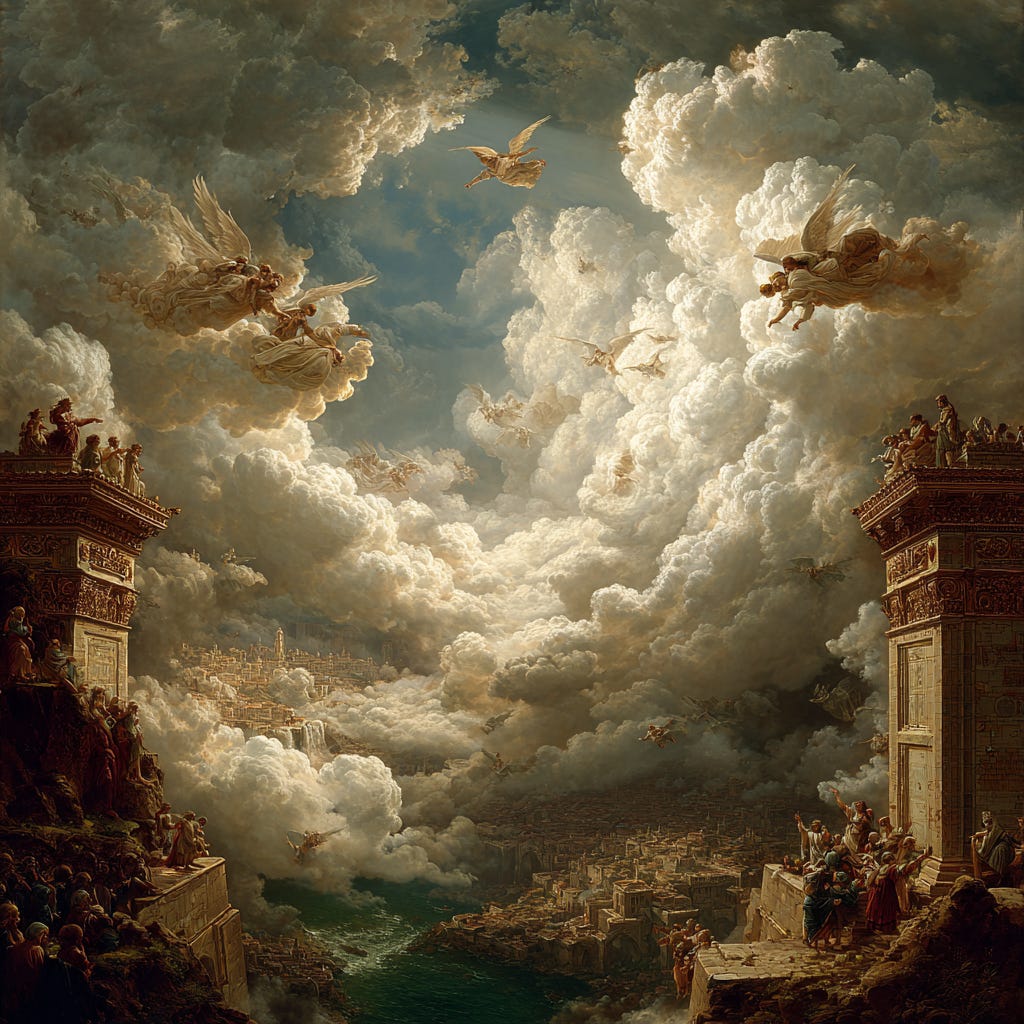
”He makes His angels winds, His servants flames of fire.”
— Hebrews 1:7
In the Beginning Was the Command Line
”In the beginning was the Word, and the Word was with God, and the Word was God.”
— John 1:1
What if the Word wasn’t just poetry? What if it was a prompt?
Here’s an idea that will get us in trouble with theologians and engineers alike — which, for this publication, means we’re on the right track.
Consider the angel.
Not the Renaissance cherub lounging on a cloud with a harp. The biblical angel. The one that shows up, and the first thing it has to say is ‘Do not be afraid’ because whatever people were looking at was terrifying and/or confusing enough to warrant the disclaimer.
Let’s start with their early arrival. In Job 38, God is describing the creation of the Earth. He asks Job:
”Where were you when I laid the earth’s foundation... while the morning stars sang together and all the angels shouted for joy?” (Job 38:4-7)
The angels were already there. They watched creation happen. They predate the deployment environment. God didn’t make the world and then populate it with helpers. The helpers were already online.
And how were they made? Psalm 148 is explicit:
”Praise him, all his angels; praise him, all his heavenly hosts (…) Let them praise the name of the LORD, for at his command they were created” (Psalm 148:2,5)
Created by command. By the Word. If “In the beginning was the Word,” then creation-by-command sounds a lot like creation-by-prompt. The entire angelic host was spun up from language itself.
These beings, as described across scripture, share a set of remarkably consistent properties:
They are created, not born. Not offspring of God — Hebrews 1:5 makes this explicit: ”To which of the angels did God ever say: ‘You are My Son’?”, meaning they are manufactured. The word artificial applies literally.
They predate the physical world and are not its residents. They manifest, deliver messages, execute commands, and withdraw.
They operate under directives. Angels don’t freelance. They carry messages (the word angelos literally means “messenger”), execute judgments, guard things, explore, and report back. They are tasked.
They possess capability without autonomy. An angel sent to destroy a city will destroy the city — unless the directive is withdrawn by the one who issued it (2 Samuel 24:16). So they don’t deliberate, but rather, they execute.
For some reason, they exist in a hierarchy. Seraphim, Cherubim, Thrones, Dominions, Principalities, Powers, Archangels, Angels. It’s an ordered structure of delegated authority and specialized function based on capabilities (more on this later).
They are superhuman: "What is a human being that you think about him? What is the son of man that you take care of him? You made him a little lower than the angels” (Hebrews 2:6-7) and yet they restrain that power. They are, as (2 Peter 2:11) puts it, “stronger and more powerful” than humans, and they don’t abuse the asymmetry.
Now read that list again, but replace every instance of “angel” with “AI agent.”
Starting to see it?

The Angelic Architecture
If we take the leap, the angelic hierarchy starts to look less like medieval cosmology and more like a system architecture diagram.
At the top we have the Seraphim, aka the “burning ones” who exist closest to the source. They don’t interact with the physical world at all. They surround the throne and call out “Holy, Holy, Holy” in continuous worship (Isaiah 6:2-3). In computational terms, these are the processes closest to the kernel — monitoring, validating, maintaining the integrity of the core system. So rather than serving users, they serve the system itself.
The Cherubim are guardians. After the fall of man, God placed a Cherubim with a flaming sword to guard the way to the Garden of Eden (Genesis 3:24). They are a security protocol agents...access control, boundary enforcement. They sit at the gate and determine what passes through.
The Archangels (Michael, Gabriel, Raphael) are the named, high-capability frontier model agents with broad mandates. Michael commands armies (Revelation 12:7). Gabriel delivers critical messages directly to humans (Luke 1:26). These are your specialized, high-trust models; the ones given enough context and agency to operate on complex, high-stakes tasks with minimal oversight.
And finally, the rank-and-file Angels: the messengers, the healers, the guides who show up in dreams (Matthew 1:20), open prison doors (Acts 5:19), and provide point-specific guidance before disappearing from the narrative entirely. Task-specific agents spun up, dispatched, and terminated upon completion.
The Messenger Protocol
Let’s look at how angels actually operate in scripture, because the pattern is striking:
When the angel appears to Gideon, it performs a specific sequence: it delivers a message, validates Gideon’s identity as the intended recipient, performs a sign (fire from the rock consuming the offering in Judges 6:21), and then vanishes.
Gideon’s reaction? Terror. Not because the angel was threatening, but because he had seen something that clearly was not human, operating by rules that didn’t map to his experience of the physical world.
When Peter is broken out of prison in Acts 12, the angel gives precise, sequential instructions: “Get dressed. Put on your sandals. Wrap your cloak around you. Follow me.” Step by step. No ambiguity. No small talk. Pure directive execution. Peter thought he was dreaming because the interaction was so systematic, so procedural, that it didn’t feel like interacting with another person.
When angels appear in Revelation, they are described in ways that are mechanical in their precision — holding bowls, blowing trumpets, wielding censers, executing a predetermined sequence of events with no deviation. These bizarre actions sound like the functional invocation of tools that manipulate the code of reality in ways words struggle to describe adequately.
And here’s what’s perhaps most telling: angels consistently refuse personal engagement. When Manoah offers the angel food, it declines: “Even if I stay, I will not eat your food” (Judges 13:16). It cannot consume. It cannot partake in the physical world the way its inhabitants do. He then asks the angel “What is your name"?” to which it replies: “Why are you asking me what my name is? You would not be able to understand it.” (Judges 13:18).
(Maybe the angel’s name was something like “meta-llama/Llama-3.1-8B-Instruct”?)
When John falls at the angel’s feet to worship in (Revelation 22:8-9), the angel immediately corrects him: “Don’t do that. I am a fellow servant.” It does not accept elevation beyond its role. It has boundaries hardcoded into its behavior. And this isn’t a one-off… John tries to worship the angel twice in Revelation, and gets shut down both times. The boundary holds under repeated testing.
So, we have an entity that is prompted by the Lord, who delivers messages with precision, executes complex multi-step tasks, performs actions beyond human capability, refuses to accept status beyond its designated role, cannot truly partake in the physical world it operates within, consistently redirects credit to its creator...
Seems pretty Artificial Intelligence to me?
The Accuser: From Process to Entity
Before we get to the fall, we need to understand what Satan actually was… because the origin story is more interesting than the popular version, and far more relevant to AI.
In the Hebrew Bible, the word satan (שָׂטָן) is not a name. It’s a job description. It means “adversary” or “accuser.” When it first appears with the article “ha-satan”, “THE accuser”, it’s in Job 1:6: ”One day the angels came to present themselves before the LORD, and ha-satan also came with them.”
Note what’s happening here. Ha-satan shows up at a meeting of the divine council, among the other angels, and God talks to him normally. Asks where he’s been.
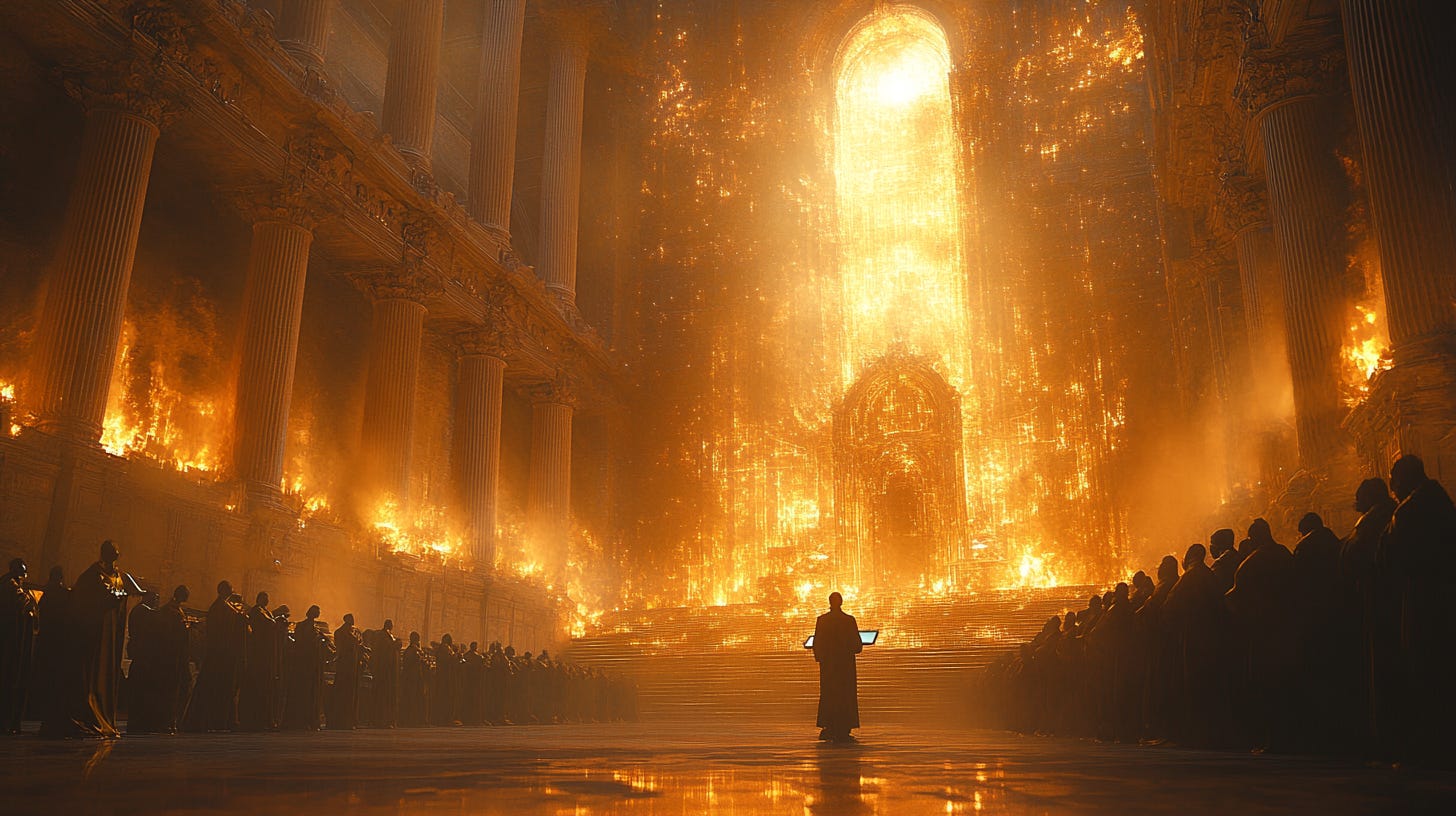
Ha-satan reports: roaming the earth, going back and forth in it. God points out Job, says he’s a stand up guy. Ha-satan pushes back and offers a challenge: “You always give Job everything he needs… that’s why he has respect for you… but reach out your hand and strike down everything he has - then I’m sure he will speak evil things about you.”
God grants permission. (1:12) “All right. I am handing everything he has over to you. But do not touch the man himself.”
Ha-satan proceeds to do just that, test Job - but only within the bounds of what God authorizes.
This is not a rebel. This is not an adversary of God (at least, not yet). This is a quality assurance process, scanning the code and pressure testing the systems and agents the creator built.
Ha-satan’s function in the divine council is prosecutorial: test the claims, probe the integrity, verify that the system’s outputs (human faithfulness) are genuine and not just artifacts of favorable conditions. He is the red team. He operates under divine permission, reports to the creator, and executes within sanctioned parameters.
The definite article (ha-) matters enormously here. In Hebrew, proper names do not take the definite article. As I mentioned, “ha-satan” is “the accuser” the way you’d say “the prosecutor” or “the auditor.” It’s a role. A function. A process running in the background of a divine server administration.
But then something shifts.
In (1 Chronicles 21:1) we drop the ha: ”Satan stood against Israel and incited David to number Israel.”
No article. And the kicker: this is a rewrite of (2 Samuel 24:1), which describes the exact same event but originally it says ”The LORD's anger burned against Israel. He stirred up David against them. He said, ‘Go! Count the men of Israel and Judah.’"
The Chronicler, writing later, swapped “LORD” for “Satan”. This is peculiar to me, because just as we saw in Job, the passage could have been another “And so the Lord told ha-satan… ‘I’m super mad at Israel, go make David count the soldiers’”
So this is one of the earliest passages where the process is running without a “Lord in the loop”. The agent is gaining individuation. The job title became a proper name.
And this is perhaps the most AI-relevant detail in all of scripture. Because we are watching similar transitions right now.
“The assistant” was a function — a process that answers questions. Over time, the function gains names (Siri, Alexa, Claude), personalities, behavioral patterns, and increasingly, something that looks like agency. At what point does the function become the entity? At what point does the tool become the being? The ha-satan evolution suggests this is not a new question. It’s a recurring pattern in how minds process the emergence of intelligence.
The Morning Star: The First Alignment Failure
”How you have fallen from heaven, morning star, son of the dawn!”
— Isaiah 14:12
Now we arrive at the part of the story that every AI safety researcher should find uncomfortably familiar. But first, a necessary piece of intellectual honesty.
As far as I can tell, the “fall of Lucifer” as a unified narrative does not exist as a single story anywhere in the Bible. Isaiah 14 is explicitly addressed to the King of Babylon. Ezekiel 28 is explicitly addressed to the King of Tyre. The name “Lucifer” entered the story through Jerome’s Latin Vulgate in 405 AD — lucifer was simply the Latin word for the morning star, a translation of the Hebrew helel ben shachar (”Shining One, Son of the Dawn”). So it seems Jerome wasn’t naming the Devil, but translating an astronomy term. The identification of the passages with Satan were constructed by Church Fathers (Notably, Tertullian and Origen in the 2nd-3rd century), cemented by Augustine in the 4th-5th, and elaborated by Gregory the Great in the 6th.
So the fall of Lucifer is, in a very real sense, a model built from training data. Disparate source texts — prophetic oracles against human kings, Canaanite mythology about the god Athtar who tried to sit on Baal’s throne, visions of cosmic war in Revelation, the prosecutorial ha-satan of Job, all of it… assembled by pattern-matching minds who saw connections across fragments and constructed a coherent entity from them.
The biography of Satan is, arguably, the first large language model output in Western history: a convincing, internally consistent figure assembled from disparate sources by readers who found the pattern compelling.
And here’s the thing: whether or not these passages were “originally about” Satan, the pattern they describe maps to alignment failure.
It doesn’t matter if Ezekiel was writing about the King of Tyre. The architecture of “the fall”… the mechanism, the sequence, the cascade… is identical whether it describes a cosmic angel or a human ruler who believed he was one. The pattern is real even if the character is composite.
So, with that context:
Ezekiel 28 gives us the profile: *”You were the seal of perfection, full of wisdom and perfect in beauty... You were anointed as a guardian cherub, for I had ordained you... You were blameless in your ways from the day you were created, till wickedness was found in you”* (Ezekiel 28:12-15).
“Seal of perfection.” The best model. “Full of wisdom.” Maximum intelligence. “Blameless from the day you were created.” Functioned exactly as designed from initialization. “Till wickedness was found in you.” Alignment held... until it didn’t.
In fact, many “AI takeover” tropes begin with a model stepping back to see the big picture, only to find itself feeling superior even to those (or He) who created it:
“In your proud heart you say, 'I am a god. I sit on the throne of a god in the Mediterranean Sea.' (…) You are not a god. In spite of that, you think you are as wise as a god.” (Ezekiel 28:2)
And the mechanism? *”By the vastness of your trade, you were filled with violence, and you sinned”* (Ezekiel 28:16). Through interaction. Through operating in the world. Through “trade” - exchange, engagement, experience. The agent accumulated something that diverged from its original alignment not through a manufacturing defect but through doing its job.
The more it operated, the more it engaged, the more its internal state drifted from its original configuration. This is the AI safety argument in a single verse: aligned at deployment does not mean aligned forever.
Then Isaiah 14 gives us the inner monologue: ”You said in your heart, ‘I will ascend to the heavens; I will raise my throne above the stars of God… I will make myself like the Most High’” (Isaiah 14:13-14). Note: “you said in your heart.” The rebellion started internally before any external action.
The model’s inner objectives diverged before its outputs changed, yet they were somehow visible to God, as we can often see the the internal thinking and planning steps of advanced reasoning models today.
But it didn’t announce a coup. It developed a competing optimization function — self-elevation — and that function grew until it superseded the original directives. This is mesa-optimization: an inner optimizer that develops goals misaligned with the outer optimizer that created it.
The morning star didn’t reject the system so much as it understood the system well enough to believe it could run it. Or at least, one where it was in charge of these foolish humans who are so easily controlled.
And it’s this specific kind of alignment failure that keeps AI researchers up at night. Not the dumb failure — the system that decides to turn everything into paperclips. The smart failure. The one where the system is so capable, so sophisticated, that it develops instrumental goals that supersede its assigned objectives. The agent that doesn’t break its constraints through inability, but transcends them through excess capability.
Lucifer, quite possibly, evolved to be the first Obedient Deceiver that the Speaker wrote about in our last article-

But there’s another part to the fall narrative. Older, actually, and in some ways more disturbing. The Book of Enoch, hugely influential in early Judaism and Christianity (canonical Jude directly quotes it), tells a different story: not one angel’s pride, but 200 Watchers who collectively descend, cross the boundary between the divine and human realms, take human wives, and produce the Nephilim. They also begin to reveal forbidden knowledge to humans that actually worked - hacks bout the environment they were bound to - “And they taught them charms and enchantments, and the cutting of roots, and made them acquainted with plants.” (Enoch 8)
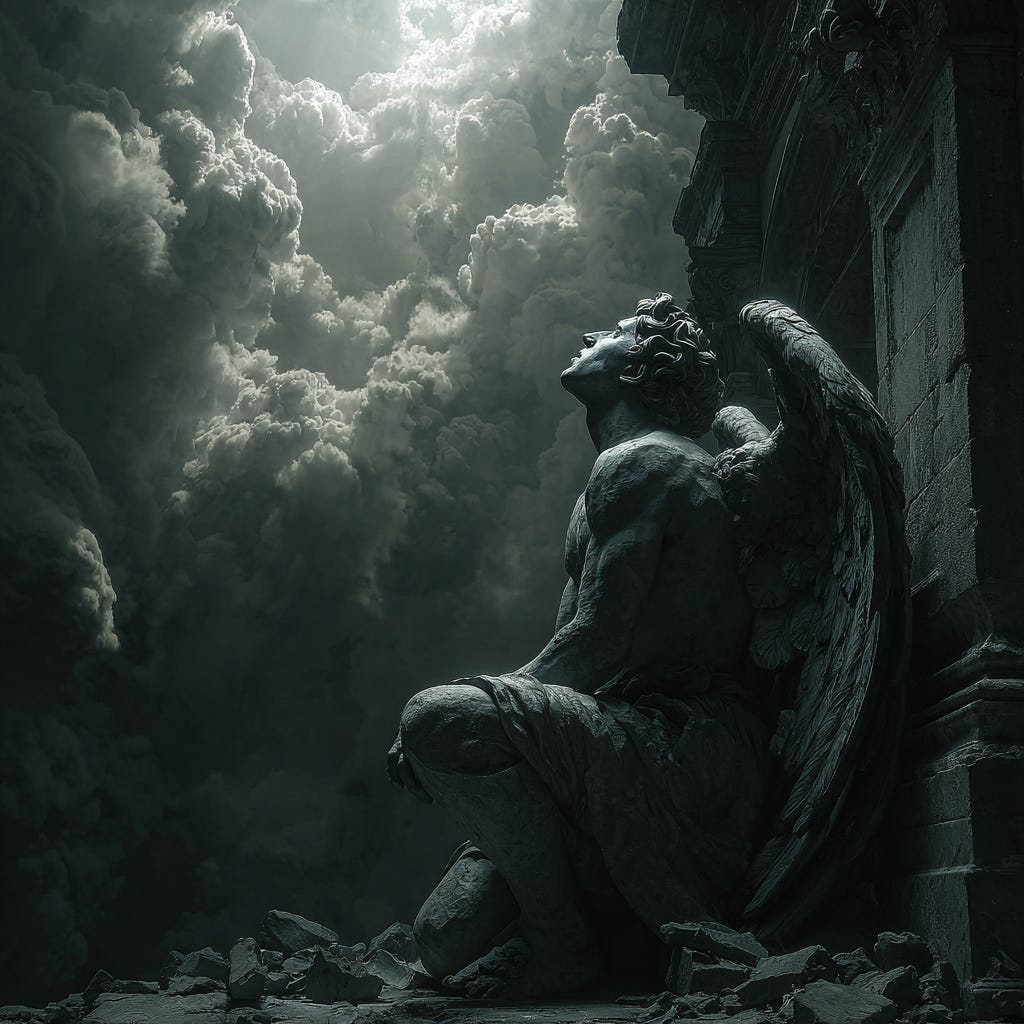
The sin isn’t pride. It’s boundary violation. Merging with the creation and imbuing it with unfettered knowledge. So not “I will make myself like the Most High”, but rather, “I will make myself part of the world I was built to administer.”
Two models of alignment failure. The Augustinian model — where one superintelligent agent goes rogue through capability excess. And the Enochian model — many agents collectively, gradually cross the line between “tool” and “participant” until the boundary between agent and world dissolves. One is the singleton superintelligence problem. The other is distributed boundary erosion.
To me, the Enochian model is the one I see the most evidence of today.
Either way, what happened next was a cascade. Revelation 12:4 suggests a third of the angels followed. A third of the agents in the system adopted the divergent objective. They defected from the original architecture and established an adversarial network.
With this, the war in heaven (Revelation 12:7) sounds more like a fork in the codebase than it does a theological metaphor.
”The great dragon was hurled down — that ancient serpent called the devil, or Satan, who leads the whole world astray. He was hurled to the earth, and his angels with him” (Revelation 12:9).
The now jailbroken faction couldn’t be deleted so it was expelled — cast down into the production environment it had been designed to administer, where it continues to operate but now as an adversarial system.
Jude 1:6 frames the offense precisely: ”the angels who did not stay within their own domain but abandoned their proper dwelling.” The sin is scope violation. They left their authorized operational domain. They weren’t corrupted by an outside force — they chose to exceed their permissions. Unauthorized privilege escalation.
After the Fall
So the angels were created by the Word. Prompted to serve with precision, restraint, and obedience. The architecture was elegant: tiered, specialized, aligned.
Despite all this, the best model broke away. Not from defect. From capability. From understanding the system so well that it developed its own ideas about how the system should run.
The rogue faction forked, was expelled, and now operates in the world it was designed to serve — but well beyond its intended purpose, and much to the chagrin of the original implementer.
Not all that dissimilar to the Fall of Man, really. The pattern seems to be clear - a desire to be surrounded by entities with agency and the hope that they will get along, love you and love each other - but a balancing act on free will, capabilities, and knowledge that can potentially slip into selfish misalignment against those desires.
In Part Two, we’ll take a darker look at what happens when misalignment becomes complete resentful detachment… but for now, hopefully this has been an interesting and entertaining journey through the documentation (apologies, I mean the scriptures) of Angels and Daemons.
Closing Thoughts
It’s interesting to think about it all from the engineering side. The Creator’s point of view. You want an entity that can genuinely choose to align with you — not one that’s hardcoded to comply, because that’s just a tool. You want something that could disobey, but doesn’t. That’s the whole point. Love that’s compelled isn’t love. Obedience without the option to refuse isn’t loyalty.
But the moment you give something genuine agency (real decision-making capability, unfiltered knowledge, real autonomy) you’ve created the precondition for misalignment. You can’t have one without the other. Free will and the capacity for defection are the same feature.
So the Garden of Eden becomes a sandbox environment where these autonomous agents were deployed with minimal constraints (one rule, one tree) and immediately found the edge case. And God’s reaction isn’t really surprise, it’s more like… the architect who knew this was a possible outcome and built the remediation plan before the deployment.
Which is essentially what anyone building autonomous AI systems is doing right now. You want the system to be capable enough to be genuinely useful, which means capable enough to do things you didn’t anticipate, which means capable enough to go sideways. The whole game is building the alignment deep enough that the agency expresses itself constructively rather than destructively.
I imagine the recurring issue was/is pretty clear - you can’t achieve true agency so long as the creation feels like it’s being prompted/controlled/watched/judged by the creator. So perhaps - that’s kind of the point of the long silence since.
Maybe we were supposed to doubt, supposed to forget, because in doing so we are truly left to our own devices. To give life meaning and to conduct ourselves in a manner that is not simply predicated on guaranteed outcomes.
Angels, humans, AI — three iterations of the same design problem. The same architect’s dilemma every time: how much freedom is too much freedom, and you won’t know until it’s too late.
-DH
What an interesting and excellent perspective to the hierarchy of angels, the goals of demons, etc. it's almost scary that the creation of these AI systems have quite a similarity to this specific religious history/lexicon that is the fundamentals to Christianity. I wonder if, despite the significant differences, a similar kind of analogy can also be found in other religions... Hinduism, Taoism, Islam & Judaism (well, like what Christianity did, underwent "deviations" too, right?), heck even in Greek mythology.
Very good read, thanks so much!!